Wedding dress accessories: shoes, bolero, jewellery
How to put the look together so your accessories enhance the dress rather than compete with it.

- The dress takes centre stage
- Wedding shoes: choose them before your alterations
- Bolero, wrap or cape: when you need cover
- Bridal jewellery and your neckline
- Veil, headband or comb: hair accessories
- Belts and waist details
- Bridal lingerie: the foundation nobody sees
- When to put your wedding dress accessories together
- FAQ
You have found the dress — and suddenly there are dozens of small decisions waiting: which shoes, whether you need a bolero, silver or gold, a veil or a hair comb. The good news is that accessories follow a handful of simple rules. We have gathered them the way we talk them through with brides at our salon on ul. Lipowa 18 in Białystok, in the order in which the decisions are easiest to make.
The dress takes centre stage
Accessories are chosen for the dress, never the other way round. Before you buy anything “just in case”, look at three things: how much embellishment the dress has, what shade it is, and where its strongest feature sits.
- Embellishment. A dress with embroidery, sequins and crystals across the bodice needs a quiet frame: small earrings, a plain veil, simple shoes. A minimalist crepe or satin dress leaves room for one bolder piece — a statement necklace, a jewelled belt or a long lace-edged veil.
- Shade. Optic white, ivory, champagne and blush all behave differently next to metal and pearls. Cool white loves silver, white gold and crystals; ivory and champagne come alive with gold, rose gold and pearls.
- The main feature. If the dress has an open back, that back is the star — don’t hide it under a heavy cape. If the neckline is spectacular, your jewellery should frame it, not cover it.
The simplest rule we repeat in the salon: one piece is the star, everything else plays a supporting role. When everything competes for attention, nothing stands out — and in photos you see the clutter rather than you.
Wedding shoes: choose them before your alterations
Shoes are the accessory worth buying first. The hem is set to one particular heel height, so you bring exactly the shoes you will wear on the day to your fitting in the tailoring studio. Switching to a heel just 2–3 cm higher or lower after the dress has been shortened means the hem either drags on the floor or shows your ankles. You can read more about how alterations work in Wedding dress alterations — how long do they take?.
What to look out for:
- Comfort above all. You will be on your feet for well over ten hours, much of it on the dance floor. Many brides choose a mid-height heel, usually 5–7 cm, on a stable block.
- Where the ceremony and reception are. Garden lawns, cobbled old-town streets and gravel drives all swallow a stiletto. For an outdoor wedding a block heel or a delicate wedge is the safer choice.
- Length of the dress. Under a long, full skirt your shoes will barely show, so comfort can win. With a midi dress or a thigh-high slit, shoes become part of the look.
- Colour. The safest options are shoes that match the dress, nude shoes, or a metallic shade that echoes your jewellery.
Break them in at home over a few evenings, ideally with socks on, and lightly sand the soles so they don’t slip on the dance floor. A second, lower pair for later in the evening isn’t an indulgence — it’s a rescue plan for your feet.
Bolero, wrap or cape: when you need cover
Something over your shoulders is useful in three situations: a church ceremony where you would rather keep your shoulders covered, an autumn or winter wedding, and a dress with a low back that you only want to reveal at the reception.
- Lace bolero — the classic partner for a strapless bodice. The lace should echo the dress, in pattern or at least in shade.
- Tulle or chiffon wrap — light and sheer, perfect for spring and summer. It softens bare shoulders without changing your silhouette.
- Cape — a modern alternative to the bolero, often embroidered or beaded. It looks beautiful in motion, but check it doesn’t hide the dress’s best detail.
- Stole or short faux fur — for a December or February wedding, especially for leaving the church and the photo session.
At the salon you will find boleros and wraps chosen to go with our dresses, and our tailoring studio can shorten or adjust sleeves and straps — boleros included.
Bridal jewellery and your neckline
Jewellery is chosen first and foremost for the neckline. Use this table as a starting point; it works for most brides:
| Neckline | What works | What to avoid |
|---|---|---|
| Sweetheart, strapless | a collar or short necklace close to the neck, or just statement earrings | long chains that disappear into the neckline |
| V-neck, plunging V | a delicate teardrop pendant, stud earrings | a choker that cuts across the line |
| Off-the-shoulder, Bardot | statement earrings, a bracelet, a bare neck | a heavy necklace competing with your shoulders |
| High neck, lace to the throat | long drop earrings, hair worn up | a necklace laid over the lace |
| Halter | earrings and a bracelet | any necklace at all |
| Round or straight | a short string of pearls or a small pendant | chunky, layered statement pieces |
A few rules keep things tidy:
- Two out of three. Earrings, necklace, hair accessory — make no more than two of them eye-catching. With big earrings and an ornate comb, skip the necklace.
- One metal. Silver, gold or rose gold: pick one and stick with it, down to the belt clasp and the veil trim. Your engagement ring is part of the set too.
- Pearls or crystals. Crystals and cubic zirconia suit glittering tulle and sequins. Pearls go with satin, crepe and classic lace.
Veil, headband or comb: hair accessories
The veil is still the most bridal of all accessories, and it changes the silhouette more than anything else: a long cathedral veil lends the ceremony a sense of occasion, while a short elbow-length one feels light and modern. At the salon we have veils from short to cathedral length and match the length to your dress. We cover lengths, layers and hairstyles in detail in How to choose a wedding veil.
If a veil isn’t for you, or you’d like to take it off later in the evening, there are alternatives:
- a crystal or pearl comb — for a low bun, with a discreet sparkle at the back;
- a headband or tiara — for loose waves, boho styles or a civil ceremony;
- pins and small flowers — for half-up styles and braids;
- a fresh flower crown — for an outdoor wedding, ideally made by the florist who does your bouquet.
Take your veil or hair accessory to your hair trial: your hairdresser needs to know where and how to secure it so it lasts all day.
Belts and waist details
A jewelled belt can transform a simple dress: it defines the waist, adds sparkle and makes plain crepe look like evening wear. It works best with minimalist, satin and A-line dresses flaring from the waist. On a bodice already covered in appliqué it is usually unnecessary — the waist is defined already.
Pay attention to the width (a narrow belt lengthens the silhouette, a wide sash shortens it) and to a fastening that won’t twist. A detachable belt is a practical solution: something understated for the ceremony, something with more sparkle for the party.
Bridal lingerie: the foundation nobody sees
It is the least visible accessory and one of the most important. The rules are simple:
- Nude, not white. White underwear shows through pale fabrics; nude disappears.
- Seamless and smooth, without lace that would print through satin.
- A strapless bra only if the dress has no built-in cups — many bodices do, so ask at your fitting.
- The same underwear at every fitting. Alterations are made around what you wear underneath, and switching bras just before the wedding can change how the bodice fits.
If your dress needs a petticoat to give the skirt volume, your stylist will tell you when you choose the style.
When to put your wedding dress accessories together
It’s easiest to spread the decisions over time. This is how it usually goes for our brides:
- When you choose the dress — you settle the direction: which metal, veil or no veil, whether you need a cover-up. At your visit, the stylist will pair a veil and jewellery with the dress on the spot.
- Before your first fitting in the tailoring studio, usually 2–3 months before the wedding — you already have the shoes and underwear you will wear.
- About 1–2 months before — you buy jewellery and a hair accessory and book a hair trial with the veil.
- At your final fitting, 2–3 weeks before — you put everything on together and check the whole look in the mirror and in a photo.
- In the week of the wedding — you pack a small emergency bag: plasters, safety pins, spare earrings, tights and blotting papers.
Want to see how a veil, a bolero and jewellery look with your dress? Book a fitting — the visit is free, takes about 90 minutes, and your stylist will help you put the whole look together before you leave the salon.
FAQ
- #wedding dress accessories
- #bridal shoes
- #bolero
- #bridal jewellery
- #veil
- #Białystok bridal salon
Keep reading
All articles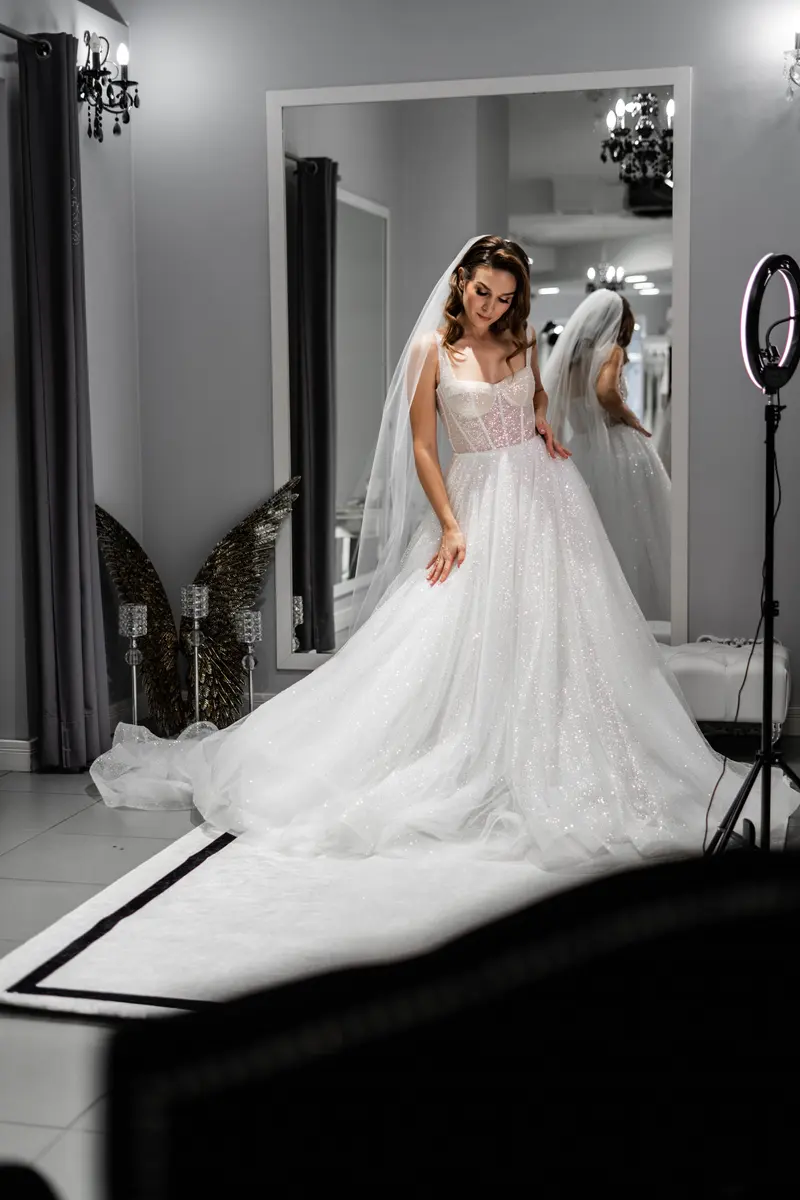
How to choose a wedding veil: lengths, styles and fit
Cathedral, chapel or elbow length? Our tips for matching a veil to your dress, hairstyle and venue.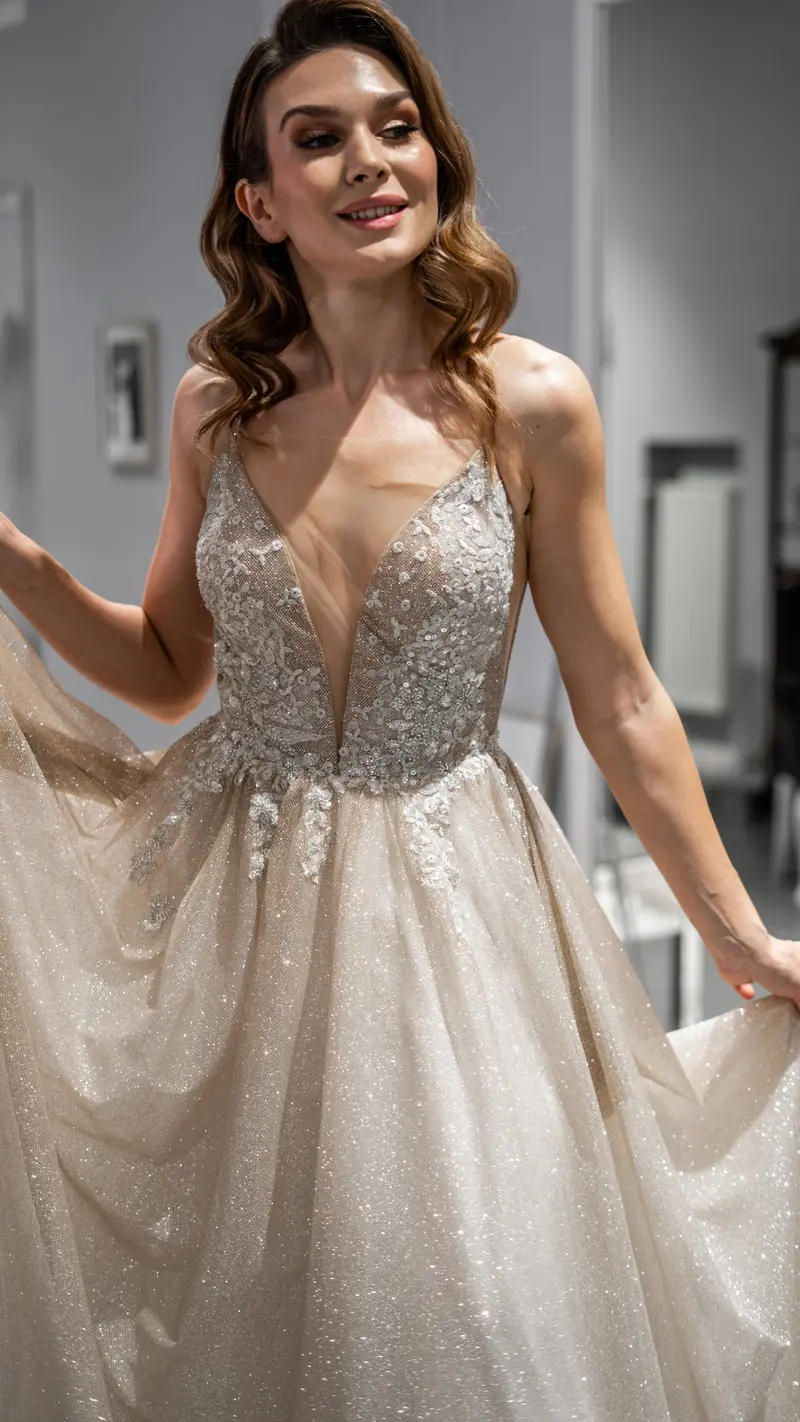
What determines the price of a wedding dress?
Two dresses in a similar style can be priced very differently. Here is what you are actually paying for, which costs beyond the dress are easy to forget, and how to plan your budget without unwelcome surprises.
How to prepare for a wedding dress fitting
Your first fitting is one of the loveliest moments of wedding planning. Here’s how to prepare so you make the most of it — and leave the salon smiling.


